
The Robot is the automatic, instinctual part of us that operates beneath our awareness. It manages habits, reactions, and shortcuts to make life easier—but can also keep us stuck in unhelpful patterns.
THE 2 PRINCIPLES
Perception IS NOT Reality
We respond to what we think is happening. But what we think is happening isn’t always what’s happening.
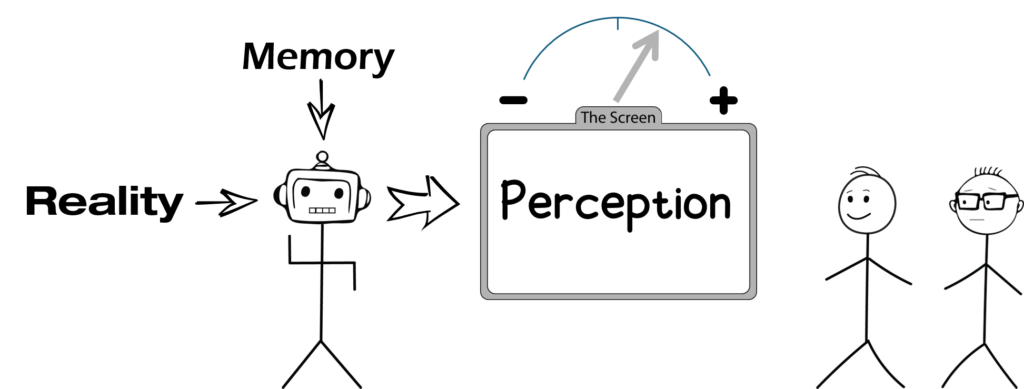
In the Three Drivers model, the picture we experience is called the Screen. The Robot uses past experiences and learned programming to interpret what’s happening and put that picture on the Screen.
Our current emotional state influences that process too. When we’re already in Protect, the Robot processes for protection. It may notice possible criticism and overlook something reassuring.
Each of us has our own Screen. Two people can experience the same situation and understand it differently. Similar experiences can produce similar pictures, but we shouldn’t assume we’re seeing the same thing.
Before reacting, ask:
“What am I seeing, and what am I assuming?”
Tell Me More
You offer an idea in a meeting. Nobody responds.
On your Screen, the silence might mean, “They don’t like it.” Someone else might see people thinking. Another person might assume everyone agrees.
The silence happened. What it means still needs to be checked.
Your interpretation may be accurate, partly accurate, or mistaken. The fact that it feels obvious doesn’t settle that question.
Past programming shapes the picture.
If you’ve learned that silence means disapproval, your Robot may put disapproval on the Screen before you consciously think about it.
Your current emotional state influences the picture too.
If you enter the meeting already upset, your Robot may be looking for danger. The silence didn’t put you into Protect. You were already there, and that affected what the silence meant to you.
Feeling confident doesn’t guarantee an accurate picture either. You might overlook disagreement because you expect support.
We can compare our Screens.
A manager may think they’re helping by giving feedback while an employee experiences it as criticism. Each interpretation makes sense to the person holding it, but either may be incomplete.
Questions help us check:
- “What did you take from that?”
- “What makes you see it that way?”
- “What else could explain what happened?”
The goal is to understand the situation more accurately before deciding what to do.
Think of something that bothered you recently. What did you notice? What did you decide it meant? What could you ask to check that interpretation?
All Decisions Are Emotional
Every decision we make—big or small—is influenced by emotion, even when we think we’re being purely logical.
- Logic provides options. Emotion drives action.
- Even “rational” decisions feel right or wrong.
- Without emotion, decision-making is impossible. (Studies on brain-damaged patients show they struggle to make choices when emotions are impaired.)
We may justify choices with logic, but emotion makes us decide.
Tell Me More
We like to think we make rational, logical decisions, but in reality, emotion is always present in the process. Research in neuroscience and psychology confirms that even our most “rational” decisions involve emotions at a core level.
Why? The Brain’s Decision-Making System
- Logic vs. Emotion: The prefrontal cortex (logic) and limbic system (emotion) work together. Logic analyzes choices, but emotion provides motivation and urgency.
- Without Emotion, We Can’t Choose: Neurologist Antonio Damasio’s research found that patients with damage to emotion-processing areas of the brain could analyze pros and cons endlessly but couldn’t make a final decision.
- Emotions Create Meaning: Facts alone don’t drive action—how we feel about those facts does. This is why marketing, leadership, and personal decisions all rely on emotional triggers.
Real-World Examples of Emotional Decisions
Buying a car? You justify it with fuel efficiency and price—but the final choice is based on how the car makes you feel.
Hiring an employee? Resumes show skills, but gut instinct and personal connection influence the final choice.
Major life changes? We analyze pros and cons, but our feelings about risk, reward, and identity make the final call.
Takeaway: Recognizing Emotion in Decisions Leads to Better Choices
Instead of pretending to be “purely logical,” successful leaders and decision-makers acknowledge emotions and use them wisely.
Ask yourself: “What’s driving this choice—fear, excitement, confidence?”
Learn to manage and guide your emotion so it is not in charge.
“We justify decisions with logic, but emotion makes them happen.”
THE 3 DRIVERS
The Robot

Overview
Tell Me More
The Robot is our autopilot system—it controls habits, reactions, and unconscious behaviors. It helps us navigate daily life without constantly thinking about every small decision. The Robot is essential for efficiency, but it doesn’t question itself—it simply repeats what it knows.
- The Good: It saves energy, helps us react quickly, and automates behaviors so we don’t have to consciously decide everything.
- The Challenge: It doesn’t distinguish between helpful and harmful patterns—it will repeat old habits, biases, and emotional reactions unless we interrupt it with awareness.
When we let The Robot run unchecked, we get stuck in patterns that limit growth, creativity, and intentional decision-making.
But when we recognize its role, we can break free from automatic responses and take more control over our actions.
Remember The Robot is programmed by Emotion, and Emotion combined with enough Logic and time is what’s needed to change it.
Roles
The Screen
Our internal perception in the moment
What it does
The Robot interprets what’s happening using our past experiences, expectations, and learned patterns. It puts that interpretation on the Screen.
Our Logic and Emotion respond to that picture. We experience it as reality, even though it is our perception of reality.
The red light
In the model, the red light on the Robot’s head represents protective processing.
When Emotion moves into Protect, imagine a switch flipping in the Robot. The red light comes on, changing what the Robot notices, what it overlooks, and what it puts on the Screen.
One of the Robot’s main jobs is keeping us safe. When the light is on, it gives possible threats more attention. A short answer may look like rejection. A question may sound like criticism. Information that suggests we’re safe may receive less attention.
The light may already be on before the next situation happens.
How the loop works
The Robot’s programming and our current emotional state shape the Screen. What appears on the Screen then influences our emotional state.
A threatening picture can deepen Protect. Protect can make the next picture look more threatening.
Logic in Override can help us question that picture. But understanding that we’re safe and feeling safe may not happen at the same speed. The red light can come on quickly and take longer to turn off.
Example
You open a short email from your boss while already upset about something else. Your Robot highlights the missing greeting and puts disapproval on the Screen.
You pause and ask, “What actually tells me they’re upset?”
You recognize that the short message alone doesn’t tell you. You may still feel unsettled, but you can check their meaning before responding.
Autopilot
Our Habitual Reactions & Default Mode
What It Does: The Robot keeps us running on default behaviors, reactions, and thinking patterns. These are things we do without thinking—some helpful (brushing your teeth), some limiting (defensive reactions in conversations).
How It Affects Us: When The Robot is in control, we’re reacting, not thinking. This can make us repeat unhelpful habits, fall into negativity loops, or resist new ways of thinking.
Example: Someone gives you feedback, and you automatically defend yourself instead of considering it. That’s Autopilot taking over.
The Comfort Zone
Sticking to What Feels Safe & Familiar
What It Does: The Robot prefers what’s known over growth. It keeps us in familiar situations—even when they’re not good for us—because staying the same feels safer than change.
How It Affects Us: It makes us resist new challenges, avoid discomfort, and fear failure. Breaking out of The Comfort Zone requires overriding The Robot and engaging Logic and Emotion to reprogram the Robot.
Example: You hesitate to speak up in a meeting, even though you have a great idea. The Robot sees it as a risk, so it keeps you quiet to avoid discomfort.
Emotion

Overview
“Many psychological scientists now assume that emotions are the dominant driver of most meaningful decisions in life. Put succinctly, emotion and decision making go hand in hand.” – Annual Review of Psychology
Emotion is the driving force behind motivation, meaning, and connection. It helps us create, protect, and respond to the world—but it can also hijack our decisions if left unchecked.
Tell Me More
Emotion is our source of energy, purpose, and instinctive reactions. It fuels our creativity, relationships, and motivation to act. Without it, we wouldn’t care about anything. But emotions aren’t just about joy and excitement—they also include fear, anger, and frustration.
- The Good: Emotion gives meaning to our work, relationships, and goals. It fuels passion, creativity, and deep connection.
- The Challenge: Emotion can override logic, causing impulsive reactions, misinterpretations, and irrational fears.
Emotion plays two primary roles: Create and Protect. When we feel safe, Emotion helps us create. When we feel threatened, Emotion switches to protection mode—often triggering automatic reactions.
Roles
Create
The Energy and Fuel that drives Decisions and Experience
- What It Does: When we feel safe and inspired, Emotion fuels creativity, connection, and personal growth. It’s what drives us to build new things, take risks, and find meaning in our work and relationships.
- How It Affects Us: In this mode, Emotion works for us, helping us take action, form deep bonds, and pursue meaningful goals.
Example: A musician lost in the moment of playing, an entrepreneur fueled by a vision, or a leader inspiring their team—all are powered by Emotion in Create mode.
Triggering
What switches us into Protect
What it does
We become triggered when something appears to threaten what we value. That might be our safety, competence, reputation, autonomy, belonging, or something else that matters to us.
The starting point can be an event, a thought, or a memory. What matters is what it means on our Screen.
The same question can look like an opportunity to one person and a threat to another because their Robots have different programming.
How it affects us
When Emotion shifts into Protect, the Robot’s red light comes on. Protective processing influences what we notice and how we interpret what happens next.
We don’t start every situation with the light off. An earlier experience may have left us protective before we enter the meeting, open the email, or hear the question.
Example
Someone asks, “Why did you do it that way?”
If your Screen shows interest, you may welcome the question. If it shows doubt about your competence, you may become defensive.
If you’re already in Protect, the question may reinforce a threat you were already feeling.
A useful question
“Did this situation trigger me, or was my red light already on?”
Protect
Defending what we perceive to be at risk
What it does
Emotion in Protect directs our energy toward defending or restoring what we value.
In the model, this flips the switch in the Robot and turns on its red light. The Robot begins processing for protection, influencing what reaches the Screen and what it means to us.
How it affects us
Protect can show up as anger, fear, urgency, defensiveness, withdrawal, or shutting down. We may feel pulled toward fighting, leaving, freezing, or appeasing.
Protect isn’t automatically wrong. Sometimes there is a real threat and action is needed. The challenge is checking whether our picture of the threat—and our response to it—fits the situation.
Active Logic may build a case for the protective interpretation. Logic in Override helps us examine it.
Why it can take time to settle
You may discover that something wasn’t what you thought. Logically, you understand. Emotionally, you may still feel upset.
The Robot can keep its guard up after the original interpretation has changed. In the model, the red light can come on quickly but take longer to turn off.
That’s why recovery may involve both checking the situation and giving yourself time to regain a sense of safety.
Example
You think someone deliberately left you out of a discussion. Later, you learn it was a scheduling mistake.
That changes what you know. It may take longer to change how you feel. You can acknowledge the lingering reaction without treating it as proof that the exclusion was deliberate.
Logic

Overview
Logic is our thinking engine and has three modes.
Understanding which mode you’re in, and learning to shift between them, is key to making better decisions, improving resilience, and maintaining balanced thinking.
- Override Mode is effortful but necessary for growth.
- Active Mode is efficient but can be misleading.
- Idle Mode is necessary for recovery and creativity.
Tell Me More
Logic processes information, evaluates decisions, and creates narratives to explain our experiences. However, Logic operates in three modes:
- Override Mode is effortful but necessary for growth—it helps us challenge assumptions, make better decisions, and refine our understanding.
- Active Mode is efficient but can be misleading—it keeps us functioning day-to-day but is prone to bias and emotional influence.
- Idle Mode is necessary for recovery and creativity—when used intentionally, it prevents burnout and enhances well-being.
Roles
Override
Thinking about our thinking
Logic in Override examines the picture we’re working from instead of automatically accepting it.
We question three things:
- The Screen: What am I assuming? What might I be missing?
- Emotion: What am I feeling? What seems threatened or important? Was I already in Create or Protect before this happened?
- Our reasoning: Am I examining the evidence, or building a case for what I already believe?
Override takes effort. It helps us consider other explanations and choose a response with a fuller understanding of the situation.
It doesn’t remove Emotion. And it doesn’t instantly turn off the Robot’s red light.
We can understand a situation differently while still feeling protective. Recognizing that difference helps us avoid using a lingering feeling as proof that our original interpretation was correct.
Tell Me More
You receive a short email from your manager about a project. Your Screen shows criticism, and you feel defensive.
Instead of replying immediately, you pause:
- “What did they actually say?”
- “What am I adding about their intent?”
- “Was I already upset before I read this?”
- “What information would help me check my interpretation?”
You ask for clarification and discover they wanted an update, not an explanation for poor work.
Your understanding changes. You may still feel tense.
Override helps you recognize both: “I misunderstood the email, and my red light hasn’t fully turned off yet.”
You can give yourself a little time before replying. You don’t need to deny the feeling or let it write the response.
The skill is recognizing that what we see, feel, and conclude can all be examined.
Active
This is where most day-to-day thinking happens. Logic still operates, but it isn’t questioning itself—it’s working in service of perception and emotion.
- Perception IS reality—we take our interpretation of the moment as truth without questioning it.
- Emotion is the dominant driver—we assume our feelings are entirely caused by the present situation.
- Logic works to justify, not challenge—we unconsciously engage in confirmation bias, cherry-picking information to validate the screen and our emotional state.
Tell Me More
Example: You receive the same vague, critical email from your manager.
- Without thinking, you assume:
- “They don’t appreciate my work.”
- “They always criticize me.”
- “This is unfair.”
- Your logic isn’t questioning the situation—it’s reinforcing how you feel.
- You immediately reply defensively: “I don’t think that’s a fair criticism. I did exactly what was asked.”
- Later, you realize you misunderstood their intent.
❌ Key takeaway: You accepted your emotional response as truth without questioning it. Your logic worked to justify your feelings rather than assess the situation objectively.
Idle
Idle mode isn’t inherently bad—it’s essential. This is when logic disengages from active analysis for rest, recreation, or avoidance.
- We don’t want to think critically—our brain takes a break from analyzing and problem-solving.
- Often aided by external influences—we might use TV, movies, music, or even substances to help us “turn off” active thought.
- Can be positive (Flow State)—in some cases, Idle mode allows us to focus intensely on an activity without distraction from past or future concerns.
Tell Me More
Example: After a long day of work, you sit on the couch and turn on Netflix.
- You aren’t analyzing anything critically.
- Your brain isn’t actively working through problems—it’s just absorbing entertainment.
- If someone asked you to solve a work-related problem, you’d probably resist:
- “I don’t want to think about that right now.”
- Positive Idle Example: If you’re in a Flow State, you might be completely engaged in a hobby (painting, playing music, sports) where your logic isn’t actively questioning—it’s just doing.
✅ Key takeaway: Idle Mode isn’t bad—it’s necessary for rest and recovery. It can also be productive (e.g., flow states), but it’s not where deep thinking or analysis happens.
THE 4 SKILLS
Drive

Overview
Juggling Three Equally Important Elements
Being Driven means balancing three key areas:
- Purpose → What and Why
- Plan → How and When
- Present → Measures and Monuments
Thought Process
Purpose
What and Why
What uses Logic. Tangible and specific targets in the future.
Why uses Emotion: What will it feel like along the way and when you are there? What is your fuel source?
Tell Me More
WHAT
Tangible things are the “what” you create, often expressed as goals. Goals are engaging until achieved, but without a meaningful “why,” they lose their power.
These need to be specific, identifiable, and measurable.
WHY
Intangible experiences are the “why” behind creation—things like feeling accomplished, making a difference, or contributing to a better world. Of the six elements of being purposeful, this is the area where most people struggle.
Pleasures vs. Gratifications:
Pleasures engage the senses and emotions. They are short-lived and easy to access, such as eating, watching a movie, or scrolling social media.
Gratifications, on the other hand, fulfill higher needs—cognitive, aesthetic, or self-actualization. They require long-term effort and bring a sense of wholeness, like parenting, creating art, or playing sports.
Assessments:
To help clarify your “why” and identify what is truly gratifying for you, we recommend two assessments:
– The VIA Character Strengths Survey (Free to $49)
– The SDI ($140)
Concepts:
Self-Determination Theory (SDT) provides a framework for understanding your “why” by identifying what truly motivates you. It highlights three core psychological needs that drive deep purpose:
- Autonomy – The need for control over choices.
- Competence – The desire to feel capable and effective.
- Relatedness – The importance of feeling connected and making an impact.
When all three needs are met, people experience genuine purpose and motivation, making SDT a valuable tool for discovering a meaningful “why.”
Finally, remember the Happiness Formula:
Happiness = Reality – Expectations.
Plan
How and When
How identifies the specific steps to take along the way. This should include Milestones that break things down into steps that use the Flow guide of +4% for the level of challenge.
When uses logic for the timeline, and emotion for the payoff along the way and in each step.
Tell Me More
Both How and When are Logic driven, and like all actions, they need an emotion/energy source. Use this as a guide to keep track of where you are sourcing your energy.
Four Categories of Engagement & Payoff:
- Bad Now / Bad Later → This engagement should be avoided. It includes bad habits or actions driven by despair and apathy, where neither the present nor the future benefits.
- Good Now / Bad Later → In moderation, this can be fine—like splurging on a purchase or eating something unhealthy. These actions bring immediate pleasure but have negative long-term consequences. While we don’t need to be perfect, this category doesn’t provide a strong foundation for meaningful engagement.
- Bad Now / Good Later → The most common type of motivation, where we endure discomfort in the present for a future reward. This looks like exercising even when we don’t enjoy it or working late to build a career. This strategy is effective but can lead to burnout if overused.
- Good Now / Good Later → The ideal motivator—doing something enjoyable that also leads to long-term benefits. This includes loving your work, enjoying exercise, or engaging in fulfilling relationships. While harder to find, this category creates sustainable motivation and lasting engagement.
Understanding these categories helps you identify which type of motivation you’re relying on and whether you need to shift your energy source for a more fulfilling and sustainable path.
Present
Measures and Monuments
Measures use logic to define what progress looks like along the way.
Monuments are reminders of your purpose that keep you emotionally engaged, helping you stay focused and committed.
Tell Me More
“You can’t get there from not here.” If we move forward with an inaccurate understanding of our present reality, we will constantly face failure and frustration, leading to disengagement.
Sometimes, we deny reality because we don’t want to deal with it. Other times, we tell ourselves lies or half-truths to feel better about where we are. And in some cases, we simply don’t know the full truth yet.
It’s also important to recognize what is driving us in the present. When motivated by Protection, we engage with our goals out of fear or avoidance rather than inspiration.
This is where the Curiosity and Collaboration skills become valuable. They help us see the present more clearly and work with others to navigate challenges, ensuring we stay connected to our purpose in a meaningful way.
Resilience

Overview
Creation is the drive to bring what you value into the world. Protection is the drive to defend or restore what you value.
We become triggered when our Screen shows a threat to something that matters to us. Emotion moves into Protect, and the Robot’s red light comes on.
That changes how we process what happens next. We may become more alert to danger and less able to consider other explanations.
Resilience is about being triggered less often, responding more effectively, and recovering faster when we are triggered.
Recovery isn’t always immediate. You may understand that a situation is safe before you feel safe again.
Resilience helps you notice the red light, examine what’s happening, and choose what to do while it settles.
Thought Process
Fix
Is this personal?
When we’re triggered, our attention narrows around the perceived threat. We may focus on the other person, what happened, or what it means for us.
Often, we interpret someone’s behavior as a statement about our worth or intentions when it reflects something happening on their Screen.
Ask:
- “What makes me think this is about me?”
- “What else could explain their behavior?”
- “Am I reacting to what they said, or what I think it says about me?”
Sometimes it is personal. Checking doesn’t mean dismissing a real problem. It helps us understand which problem we actually need to address.
Their behavior is theirs. Our task is to work with our own response and decide what action fits the situation.
What are you protecting?
Asking, “What am I protecting?” is key to understanding what’s making you feel unsafe.
Being triggered is a fear state, but it’s often easier to identify what we feel is at risk rather than the fear itself.
If we felt completely safe, we wouldn’t be triggered.
The real source of the threat isn’t always obvious—it might be status, reputation, certainty, or belonging.
Once you identify the risk, it’s easier to decide how to restore safety and move forward.
What can you control?
Sometimes we get triggered because we are trying to control things outside of our control.
Triggers often come from fighting reality—wishing someone behaved differently, expecting control over unpredictable factors.
Shifting focus to what you can influence reduces stress and helps regain stability.
If you can’t control the situation, you CAN control your response to it.
How triggered are you?
As Protect intensifies, our attention can become narrower and our sense of urgency stronger.
Use these three levels as a way to recognize where your attention has gone:
Level 1: “I WANT to fix this.”
You still have room to think about the other person and the wider situation. You want a resolution, but you can consider more than the immediate threat.
Level 2: “I NEED to fix this.”
Your attention is concentrated on what triggered you. Other information and priorities become harder to consider.
Level 3: “I’m DESPERATE to fix this.”
Your attention is dominated by your own need for safety or relief. It becomes much harder to consider another person’s perspective.
These are guides for noticing your state, not labels to judge yourself with.
Ask: “Do I have enough room to think clearly right now, or do I need to settle before I continue?”
What do you need to feel safe?
First, check whether there is an actual threat that requires action. Restoring safety may mean setting a boundary, leaving a situation, getting help, or resolving a practical problem.
When the immediate danger is absent or has passed, your Robot may still be processing for protection. The red light can take time to turn off.
Ask:
- “What still feels at risk?”
- “What information or action would help?”
- “Do I need time before I continue?”
Different situations call for different responses:
Calm Down: Lower the intensity. Pause, take some space, or slow the conversation.
Speed Up: Take a useful step when feeling stuck or unable to act is part of the threat.
Figure Out: Gather information when uncertainty is keeping your guard up.
The aim is to regain enough safety and flexibility to choose your next action. You don’t have to force yourself to feel fine immediately.
Prevent
Strengthen Logic
We can reduce the chance of being triggered by strengthening how we think:
- Rest and exercise → A healthy brain handles stress better.
- Mindfulness/Self-Awareness → Observe yourself instead of reacting automatically.
- Build the Drive, Curiosity, and Collaboration skills → These all support resilience.
Debugging
The Robot holds onto conditioned responses that make us trigger-prone. Debugging removes unhelpful conditioning:
- Understand fear → There is no bear chasing you.
- Don’t take things personally → Most people act based on their experience, not you.
- Do a Safety Assessment → Is there an actual threat, or just a perceived one?
- Have a Plan → Know how you’ll respond to common triggers.
Spot
What’s Their Focus?
When people are triggered, their focus narrows to what feels like a threat.
Use the three levels to gauge how triggered they are:
- Level 1: Focused on you.
- Level 2: Focused on what triggered them.
- Level 3: Focused only on themselves.
Look for the 3 Energies
People express triggers in different ways. Learn how different triggering can look in different people.
- Calm Down: Withdrawn or Uncomfortable.
- Speed Up: Amped Up or Urgent.
- Figure Out: Distant or Interrogating.
Help
Help them regain a sense of safety
Someone whose red light is on may hear your explanation through a protective filter. Repeating your point more forcefully can make that worse.
Start by understanding what appears to be at risk for them.
Work with them. Ask what would help, acknowledge what you understand, and avoid forcing a solution.
If they need to Calm Down:
Lower your own intensity. Give them room to pause. Telling someone to “calm down” can sound dismissive; offer time or space instead.
If they need to Speed Up:
Acknowledge their urgency and identify a useful next step. Help direct the energy toward a solution.
If they need to Figure Out:
Slow down, reduce the emotional intensity, and help examine the situation. Separate what is known from what is assumed and identify what still needs to be clarified.
You can help someone check the picture and feel safer, but you can’t switch off their red light for them. Even after an issue is resolved logically, recovery may take time.
Curiosity

Overview
Curiosity is the willingness to examine what we believe, including the possibility that we’re missing something or mistaken.
Our Robot makes familiar interpretations feel obvious. Logic in Override helps us question those interpretations, and Curiosity gives us a way to practice doing that.
When the red light is on, questioning our picture can feel threatening. We may look for confirmation while believing we’re looking for understanding.
Being curious means making room for different or competing information and letting it affect our thinking.
The goal is a more accurate picture and a better decision.
Thought Process
Are you curious?
Are you willing to learn something new or discover that something you believe is mistaken?
It’s often easier to notice whether you feel curious than to recognize a specific bias.
Ask:
- “Do I want to understand, or do I want to prove my point?”
- “Would I seriously consider information that challenged my view?”
- “Is my red light on?”
If questioning feels like a threat, use the Resilience skill to help you regain enough safety to explore.
Tell Me More
Our interpretations rarely feel like interpretations. They feel like what happened.
That makes it easy to search for information that confirms our Screen and call it curiosity.
Genuine curiosity includes the possibility that the answer won’t be the one we want.
Protect can make this harder. If admitting a mistake threatens our sense of competence or belonging, the Robot may highlight reasons to defend our position.
Create doesn’t guarantee an accurate picture either. Excitement about an idea can make us overlook its weaknesses.
Curiosity helps us notice both possibilities.
Ask: “What information would make me reconsider?”
If the answer is “nothing,” that’s worth noticing before gathering more evidence.
What's at stake?
Questioning our thinking takes effort. We can’t examine every assumption all day, so we need to decide where that effort matters.
Ask:
- “What could happen if my interpretation is wrong?”
- “Who will be affected by this decision?”
- “How much effort does checking it deserve?”
Recognizing the stakes can motivate us to question a belief. Attachment to a preferred outcome can also make questioning harder.
The aim is to care enough about the decision to examine it—even when that means changing our mind.
Tell Me More
An important decision gives us a reason to slow down and check our thinking. It can also give us more to defend.
We may have invested time, money, reputation, or hope in a particular answer. That investment can make contradictory information feel threatening.
Notice the difference between wanting a good outcome and needing your current answer to be right.
Ask:
- “Am I resisting this information because it’s unreliable, or because I don’t like what it means?”
- “What am I protecting?”
- “What would I advise someone else to examine?”
- “Would changing my mind now prevent a bigger problem later?”
Use the stakes to decide how carefully to investigate. Then check whether your attachment to the outcome is influencing the investigation itself.
What do you want to be true?
What do you want to see? What is your emotional state (Create or Protect?)
Are you hoping for confirmation of what you currently believe to be true?
Being unbiased requires being open to different or competing information.
Tell Me More
Bias is hard to see, but it is easier to identify what you want to be right about – which is bias.
We can then remember that we overvalue the things we want to be right about and prevent confirmation bias.
Confirmation bias often disguises itself as curiosity. We think we are looking for what’s true when we are actually looking to protect the comfort zone.
What will you base this decision on?
Decide what evidence, experience, and criteria should guide your choice.
Ask:
- “What do I need to know?”
- “Who has relevant knowledge or a different perspective?”
- “What would count as good evidence?”
- “What matters most in judging the options?”
Use clear, reliable criteria while examining how emotions and assumptions influence the decision.
Emotion helps explain why the outcome matters to us. Logic in Override helps us check whether our reasoning and evidence support the choice.
Tell Me More
Start by examining your sources.
Are you relying on someone because they know the subject, or because they agree with you? Are you the right person to judge the evidence alone? Is it time to collaborate?
Different perspectives can reveal something missing from your Screen. Relevant expertise helps you assess what those perspectives are based on.
Separate:
- What is known.
- What is reasonably inferred.
- What is assumed.
- What remains uncertain.
When knowledgeable people disagree, examine their evidence and reasoning. Agreement alone doesn’t settle a question, but choosing a minority view because you prefer it isn’t enough either.
The Robot may favor familiar interpretations. Emotion may pull you toward an outcome you want or away from one you fear.
Logic in Override helps you examine those influences, test your assumptions, and consider information that doesn’t fit your current picture.
Before deciding, ask:
“Can I explain the evidence, the criteria, and the trade-offs behind this choice? Have I taken the strongest challenge to my view seriously?”
Collaboration

Overview
Our understanding of the world is greatly limited.
Big challenges bring great complexity and a greater need to gather others’ perspectives.
Being Collaborative is about building stronger relationships and buy-in as well.
“Great discoveries and improvements invariably involve the cooperation of many minds.” Alexander Graham Bell
Thought Process
Do you want to collaborate?
Do you truly want to see what you don’t currently see?
Do you have the time to invest right now?
Our understanding of the world is greatly limited; true collaboration is about borrowing someone else’s screen.
Tell Me More
Confirmation bias, or seeking out information that validates our current beliefs, can disguise itself as curiosity and collaboration. This can create the Illusion of Inclusion.
Your Robot can perceive collaboration as a threat to the Comfort Zone and sound alarms to avoid it.
We may also be hesitant to deeply collaborate out of fear of looking like we don’t already know.
Collaboration can be a clever way to avoid making a decision or share the blame with others.
The benefits of collaboration are making better decisions and building stronger relationships and buy-in.
Who are the right people?
“Great discoveries and improvements invariably involve the cooperation of many minds.” – Alexander Graham Bell
Choosing to collaborate is important, but choosing who to collaborate with is just as important.
Tell Me More
When searching for the right people to collaborate with, it helps to ask yourself these questions:
– Who has a viewpoint different from mine?
– Am I choosing someone just because they agree with me?
– Will they tell me the truth?
– Have I built enough emotional capital to ask them?
– What are my blind spots, and who can see past them?
– What skills don’t I have?
When Meeting
The purpose of this conversation is to collect, compare, and contrast what different people have on their Screens.
Each person has their own picture. Start by understanding those pictures before evaluating the options or deciding what to do.
1. State your intention.
Explain that you want to listen, learn, and collect information. Be clear about whether a decision will be made now or later.
2. State the issue briefly.
Give enough context to understand the topic without presenting your entire case first.
For example: “I want to exercise more,” or “Our handoffs keep creating extra work.”
3. Ask what’s on their Screens.
How do they understand the situation? What have they experienced? What do they notice that you might not?
At this stage, ask for their perspective before asking for advice.
4. Check your understanding.
Summarize what you heard and let them correct it. Understanding their Screen doesn’t require agreeing with every interpretation.
5. Share what’s now on your Screen.
What has changed in your thinking? What still looks different? What needs more investigation?
6. Ask for advice or consider options.
Now explore what might work. Listen, take notes, and ask questions before defending or dismissing an idea.
Watch for the red light.
If someone feels judged or threatened, their Robot may process the conversation for protection. That can make another perspective harder to consider.
Slow down, clarify your intention, and use the Resilience skill to help restore safety. You may need a pause before continuing.
A useful conversation allows people to question ideas while remaining able to learn from each other.
Follow-up
Others invested their time and energy to help you, so show your appreciation by letting them know the outcome.
This prevents the Illusion of Inclusion and builds Emotional Capital.
It is also a good form of support to help you take the steps needed to achieve your goals.
is proudly powered by WordPress