
The Three Drivers of Decision-Making Program
Help your organization understand everyday choices, build better decision-making skills, and put them into practice.
Why Decision-Making?
Most training is ultimately about helping people make better choices—even when we don’t call it decision-making. Leadership, communication, collaboration, and even culture work all come down to what people choose to do next. A leader’s central responsibility is to make those choices—or influence how others choose.
When an organization treats decision-making as a conscious, purposeful skill, people gain a shared way to understand their choices, question familiar responses, and act with intention. The Three Drivers gives them that common understanding and a practical approach to use every day.
Better choices then lead to better results.
How the program works
Start by understanding how decisions get made today. Then build practical skills and help leaders reinforce them in everyday work.
Assess
Start With Now
We start with the Organizational Decision-Making Assessment, which surfaces the habits, assumptions, and hidden choices that shape your results—including how AI supports your decisions today and where it could help.
Tell me more
Before the assessment, we agree on the groups, shifts, and decisions that matter most. We talk with leaders and employees across the organization to see how those decisions actually get made.
We look at recent examples. Who had the information? Who had the authority to act? What made it easier or harder to raise a concern, take ownership, or follow through? These conversations help uncover the habits, assumptions, and priorities shaping the outcome.
Because AI is a decision-making tool, we bring in technology experts from Ledge Inc. as part of the assessment. Together, we examine how you use AI today, where it could improve everyday work, and where human judgment matters most. We consider your systems, data, and people’s readiness alongside what we learn from those conversations.
You receive a summary of what’s working, the hidden choices and obstacles we found, and practical priorities to act on—including where AI could help and what to explore first.
Scope and Pricing
$5,500
Up to 50 employees, including the AI evaluation with Ledge Inc. Add $750 for each additional block of up to 25 employees.
We confirm the groups, shifts, and workflows involved before work begins. AI implementation, training, and leadership development are scoped and priced separately.
Travel is additional for in-person delivery when needed.
Build Skills
Strengthen Decision-Making Skills
The Three Drivers Course teaches teams to recognize what’s driving their decisions and choose how to respond. In engaging sessions, they practice those skills on real workplace challenges.
Tell me more
Foundation · 3 hours
Explore the Two Principles, Three Drivers, and Four Skills that make up the full model. Participants use familiar workplace situations to notice what they assume, what they care about, and how they tend to respond.
We also apply the model to some of today’s biggest workplace challenges: adopting AI, working across generational differences, navigating constant change, building a culture that supports better choices, and doing more with less. Participants explore how habits and emotions influence their responses—and practice using the Four Skills to question assumptions, adapt their approach, and work through these challenges together.
Follow-through · Four 1-hour sessions
Each session focuses on one skill: Drive, Resilience, Curiosity, or Collaboration. Participants try the skills between sessions, bring back what happened, and plan how to use them on their next challenge.
Available in person, virtually, or in a mix of formats. We can start with one group or a pilot session. Explore the model to see what your team will learn.
Scope and Pricing
$3,500 per group
Includes the three-hour foundation and four one-hour follow-up sessions.
Pricing may vary based on group size. Reduced rates are available for small organizations and nonprofits.
Available in person, virtually, or in a mix of formats. We confirm the group and delivery format before work begins.
Travel is additional for in-person delivery when needed.
Reinforce
Measure and Develop
Lasting change takes measurement and reinforcement over time. We work with leaders and teams to review progress, work through obstacles, and make better decision-making part of how your organization works.
Tell me more
Leaders bring real decisions, conversations, and team challenges to coaching. We prepare for what’s coming up, reflect on what they tried, and identify what they can do differently the next time.
Together, we agree on what progress should look like and when to review it. That might mean concerns raised earlier, clearer ownership, or more reliable follow-through. We look at which practices are taking hold, where people still get stuck, and what support would help next.
Scope and Pricing
Scope and pricing vary based on your needs.
Includes follow-up and reinforcement sessions with teams and senior leadership, plus one-on-one coaching where needed.
We agree on the participants, session frequency, and duration of support before work begins.
Travel is additional for in-person delivery when needed.
Choose a starting point that fits your team. Begin with an assessment, run the course with a specific group, or try a pilot session. We can tailor the scope and sequence to your priorities.
Explore the Model
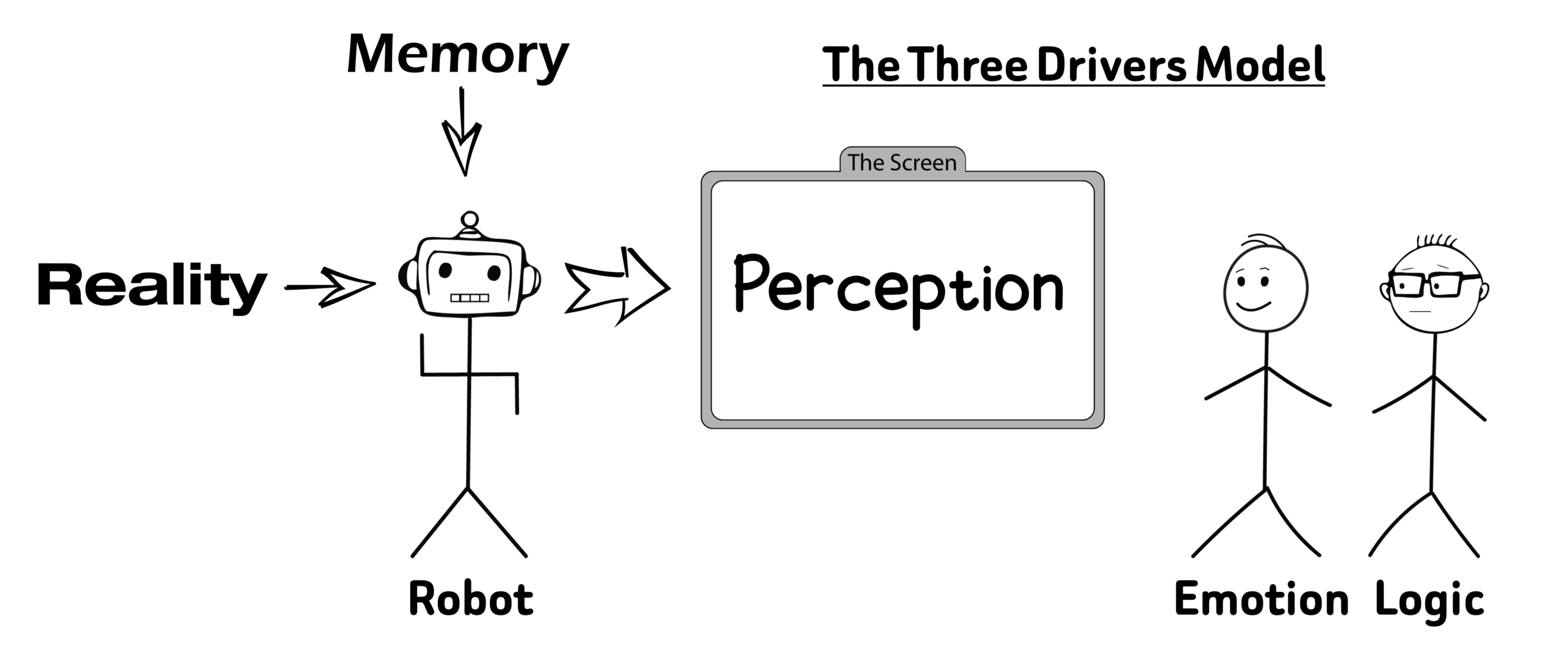
The Three Drivers explains how and why we choose. The principles, drivers, and skills each play a part in how we respond.
Two Principles
- Perception is not reality. We respond to our interpretation of events. Recognizing this helps us get curious about different perspectives instead of arguing over who’s right.
- All decisions are emotional. Emotion gives choices meaning, even when they feel purely logical. Often, what feels like a logical choice is reasoning used to justify what we already want. The skill is recognizing its influence and being honest about what’s driving us.
Three Drivers
- Robot filters the moment through memory and conditioning, shaping our perceptions and automatic responses. The skill is knowing when to question them.
- Emotion fuels action toward what we want to create or protect. Learning to channel that energy helps us follow through and create results.
- Logic helps us test perceptions, weigh options, and plan a way forward—not just justify the choice we already want to make.
Four Skills
- Drive connects what matters to us with purposeful action.
- Resilience helps us stay focused amid chaos, regain perspective under pressure, and recover quickly from setbacks.
- Curiosity helps us question assumptions, uncover blind spots, and spark innovation.
- Collaboration brings other perspectives into the decision and builds commitment to what happens next.
Let’s Talk About AI
The Three Drivers helps people make better choices, and AI is a decision-making tool. The question is where it can help your people do better work and where their judgment matters most.
As a standard part of the assessment, we work with Ledge Inc., our AI implementation partner. Ledge has spent four years helping organizations put AI to work in day-to-day operations. Together, we look at how work gets done and where AI could make a useful contribution, given your systems, data, and team’s readiness.
If you’re getting started
Identify which uses to test first and what you’ll need to try them.
If you’re already using AI
Find ways to improve or unstick existing initiatives while uncovering how people are using AI behind the scenes.
What the AI evaluation includes
- Make sense of a changing AI landscape. Cut through the overwhelm of new tools and possibilities to focus on what matters for your organization—and what can wait.
- Choose workflows to explore. Agree on what results you want to improve and review relevant AI efforts already underway.
- Understand how work gets done. Talk to the people doing the work and those responsible for systems. Review what information teams use, who can access it, and what approvals or connections would be needed.
- Compare opportunities. Weigh business value, effort, technical feasibility, and readiness. Identify where human review matters.
- Decide what to try first. Review a ranked list of opportunities and agree on what to test, who should be involved, and how to measure progress.
Implementation is scoped separately.