The Three Drivers Model
Understand what drives the choice.
Better choices begin with understanding how we make them. The Three Drivers is a practical model for recognizing the perceptions, automatic responses, emotions, and reasoning that shape what we do next.
Here, we explore the Two Principles, Three Drivers, and Four Skills in more detail. Start with the short descriptions, then open “Tell me more” to see how each part works—and how to use it in your own decisions and with your team.
Two Principles
Understand what shapes every choice.
Perception is not reality.
We respond to our interpretation of events. Recognizing this helps us get curious about different perspectives instead of arguing over who’s right.
Tell me more
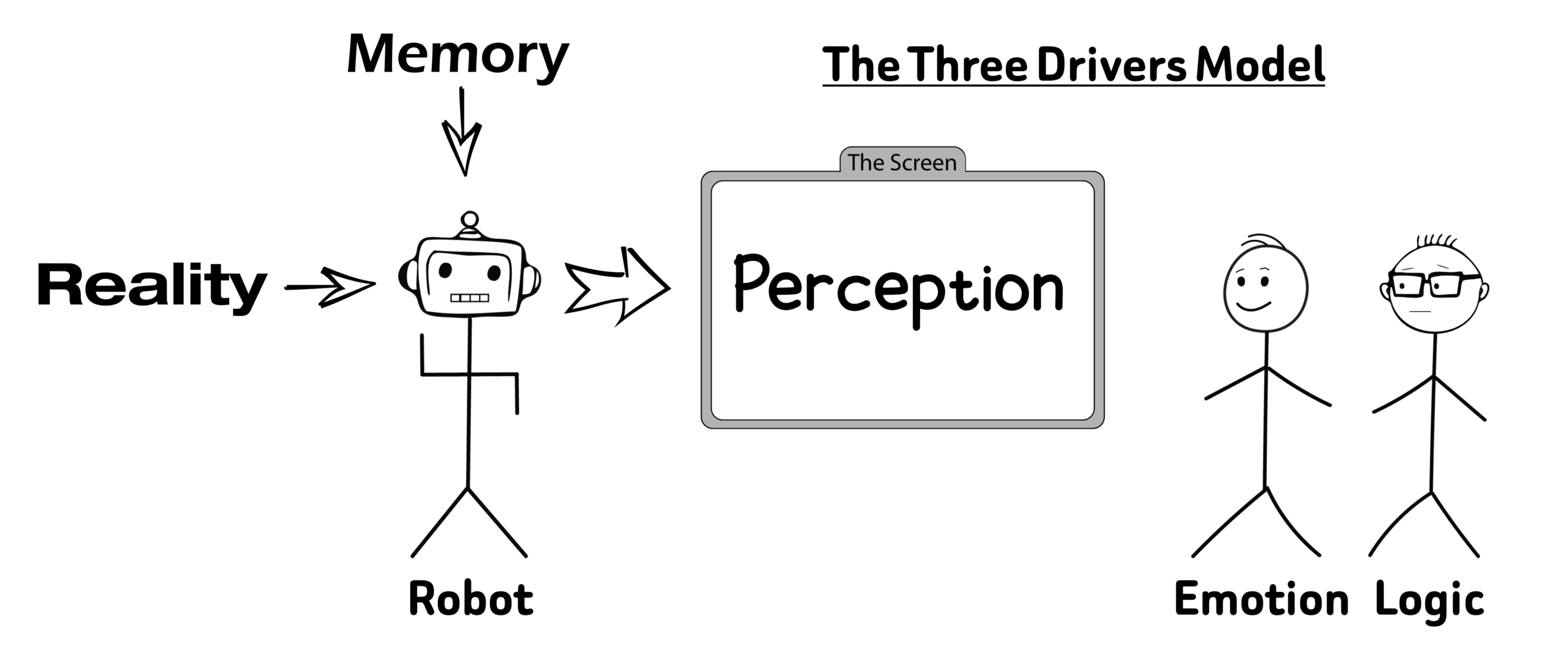
Two people can experience the same situation and see it very differently. What each person notices—and what they assume it means—is shaped by memory, expectations, and past conditioning. In the model, the Screen represents that perception.
When this understanding becomes part of a culture, disagreement becomes an opportunity to learn. We can separate what happened from what we added, ask what someone else sees, and revise our understanding before responding.
What did I observe, and what am I assuming?
All decisions are emotional.
Emotion gives choices meaning, even when they feel purely logical. Often, what feels like a logical choice is reasoning used to justify what we already want.
Tell me more
Sometimes the emotion is obvious. Other times, we feel certain we are being logical while our reasoning supports a preference we have not examined. A wish to protect our credibility, avoid discomfort, or create something worthwhile can shape which options we consider.
Emotion doesn’t make a decision bad. The skill is recognizing its influence and being honest with ourselves about what’s driving the choice. When we don’t, emotion can steer the decision without being questioned.
What am I trying to create or protect?
Three Drivers
Notice how automatic processing, emotion, and logic work together.
Robot
Robot filters the moment through memory and conditioning, shaping our perceptions and automatic responses. The skill is knowing when to question them.
Tell me more
Robot is our name for the brain’s automatic processing. It filters what’s happening through memory and past conditioning, shaping the perception our emotion and logic respond to. It does much of the heavy lifting, usually well.
Familiar patterns help us act quickly without reconsidering everything. But a familiar reaction may not fit a new situation. Learning to notice those moments gives us a chance to question the perception or interrupt the response before it determines what happens next.
Is this response useful now, or simply familiar?
Emotion
Emotion fuels action toward what we want to create or protect. Learning to channel that energy helps us follow through and create results.
Tell me more
Emotion gives a choice meaning and motivates us to act. Based on how we perceive a situation, it moves us toward something we value or away from something that feels threatening.
The aim is not to eliminate emotion. It is to recognize what matters to us and channel that energy deliberately. Connecting with something we want to create can help us find the drive to persist, while noticing what we are protecting can reveal why we feel stuck.
How can I direct this energy toward a useful result?
Logic
Logic helps us test perceptions, weigh options, and plan a way forward—not just justify the choice we already want to make.
Tell me more
Logic helps us examine our perceptions, compare options, and turn what matters into a plan. It lets us ask what evidence supports an interpretation, what alternatives we have missed, and what consequences might follow.
Its value depends on how we use it. We can reason our way toward a better understanding, or build a convincing defense of our first reaction. Deliberately looking for information that could change our mind helps keep logic useful.
Am I testing my thinking or defending my first answer?
Four Skills
Turn understanding into choices you can practice every day.

Drive
Drive starts with a strong sense of personal purpose that helps us stay focused amid distractions and change.
Tell me more
Connecting what matters to us with what the organization is working to achieve gives our work meaning—and fuels the commitment to move it forward.
That connection helps us decide what deserves our attention when competing demands pull us in different directions. Drive translates personal purpose into priorities, deliberate action, and the willingness to follow through.
What matters enough to deserve my energy today?

Resilience
Resilience helps us stay focused amid chaos, regain perspective under pressure, and recover quickly from setbacks.
Tell me more
Resilience starts with noticing when pressure is shaping our perception and response. We learn to create enough space to regain perspective before an automatic reaction takes over.
It does not mean ignoring frustration or pretending a setback is fine. It means acknowledging what happened, deciding what is within our influence, and choosing a useful next step. With practice, we can respond more effectively and recover more readily.
What would help me regain perspective and take the next useful step?

Curiosity
Curiosity helps us question assumptions, uncover blind spots, and spark innovation.
Tell me more
Curiosity makes room for the possibility that our first interpretation is incomplete. We ask questions to learn, seek perspectives we do not already share, and look for evidence we might otherwise overlook.
In teams, this creates room to challenge familiar approaches without turning disagreement into a contest. Exploring what we have missed can reveal better explanations, new options, and opportunities for innovation.
What might I be missing, and who could help me see it?

Collaboration
Collaboration brings other perspectives into the decision and builds commitment to what happens next.
Tell me more
Collaboration means working with differences rather than expecting everyone to see the situation the same way. We make room for concerns, compare priorities, and develop a clearer understanding of the result we are trying to achieve together.
It also means turning that understanding into action: agreeing on the decision, clarifying ownership, and following through. The goal is not agreement on everything, but a way forward people understand and can support.
What do we need to understand and agree on to move forward together?
Why this model matters
The Three Drivers gives individuals and teams a shared way to understand their choices—and make better ones.
For individuals
Recognize what is shaping your response before it becomes your decision. Question a familiar interpretation, understand what matters to you, and choose how to act with greater intention.
For organizations
A shared understanding of decision-making helps people align around goals, work through differences, and build a more consistent culture. It connects the choices people make every day with the organization they want to create together.